
Professor Dr. Kittipan Rerkasem
Leg Vein Clinic Thailand
Many patients notice “spider veins” or telangiectasia around the ankle or the top of the foot and become worried that they may be a sign of a serious disease. Some think they are merely cosmetic and ignore them. In reality, the location of these spider veins is more meaningful than most people realize—especially around the ankle, which is a key area for assessing the health of the venous system.
This article explains:
- What spider veins around the ankle are
- What conditions they may indicate
- Whether they should be taken seriously or can be ignored
- Appropriate evaluation and treatment options
What Are Spider Veins Around the Ankle?
The red–blue tiny veins visible around the ankle are called telangiectasia or spider veins. They result from abnormally dilated superficial venules under the skin, typically measuring 0.1–1.0 mm in diameter.
Spider veins can appear anywhere on the body, but when they occur around the ankle, they carry special significance, because this is the area where venous pressure is highest when there is venous reflux or venous insufficiency.
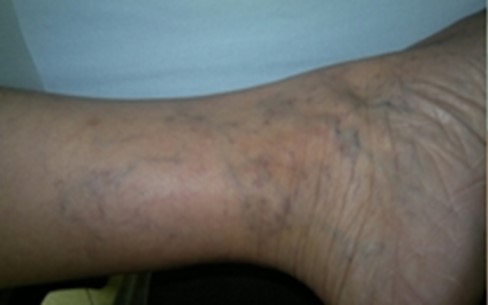
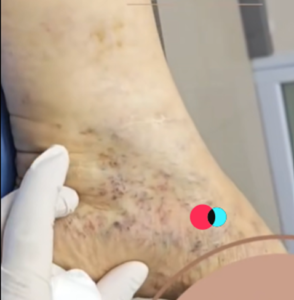
Image show spider vein around ankle
Why Are Spider Veins Around the Ankle Important?
Spider veins around the ankle may indicate:
- Underlying venous reflux from major leg veins such as the Great Saphenous Vein (GSV)
If the venous valves are incompetent, blood flows backward and increases pressure at the ankle, causing small veins and venules to dilate.
Many studies show that:
- Patients with ankle spider veins have a higher likelihood of underlying venous reflux
- Especially when the pattern is known as “Corona Phlebectatica”
What Is Corona Phlebectatica? Why Do Vein Specialists Pay Close Attention to It?
Corona Phlebectatica is a group of tiny dilated veins forming a fan-like or circular pattern around the ankle. It is one of the signs used in the CEAP classification to grade chronic venous disease severity.
It is considered an early indicator of progressive venous disease.
If left untreated, it may lead to:
- Leg swelling
- Skin discoloration
- Redness or inflammation
- Larger varicose veins
- Chronic venous ulcers
Therefore, this finding should not be dismissed.
Can It Be Ignored?
This depends on several factors.
1) Are there symptoms?
If any of the following symptoms accompany ankle spider veins, they should not be ignored:
- Pain, heaviness, leg fatigue in the evening
- Ankle swelling
- Itching or burning
- Tenderness along the spider veins
- Heaviness when walking long distances
These symptoms often correlate with big vein venous reflux e.g.GSV. These also should consult expert.
2) What do the spider veins look like?
- If they cover a wide area or appear in multiple clusters → suspect corona phlebectatica
- If only 1–2 small veins appear without symptoms → likely cosmetic
- If extensive → should be evaluated by a specialist
3) Patient risk factors
If any of the following risk factors exist, monitoring and evaluation are recommended:
- Prolonged standing or sitting
- Obesity
- Pregnancy
- Family history of varicose veins
- Previous surgery or deep vein thrombosis
- Age > 60
How Should It Be Evaluated?
The best diagnostic method is:
Duplex Ultrasound
This test assesses reflux of major veins such as the great saphenous vein. It takes 10–15 minutes and is the global gold standard.
Visual inspection alone is not sufficient for diagnosis.
Do They Need Treatment? What Are the Options?
Treatment depends on the underlying cause.
Case 1: No major venous reflux (cosmetic problem)
The most effective treatment is:
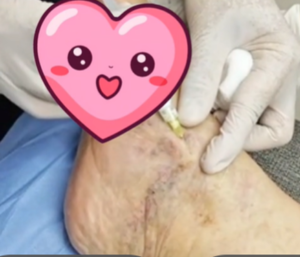
- Sclerotherapy
Injection of a sclerosant to close the spider veins.
Takes 10–15 minutes; healing occurs within 1–2 weeks.
- Compression stockings
Help reduce venous pressure and prevent recurrence.
Case 2: With major venous reflux
The underlying cause must be treated first, otherwise spider veins will return even after injection.
Treatment options include:
- Endovenous Laser Ablation (EVLA)
- Radiofrequency Ablation (RFA)
- Medical-grade vein glue closure
After treating the main refluxing vein, spider veins can be injected if necessary.
Correcting the root cause helps the spider veins fade and prevents future venous ulcers.
Key Summary: Spider Veins Around the Ankle Should Not Be Ignored
- They are not merely cosmetic
- They can be an early sign of venous reflux
- If found around the ankle with symptoms → consult a specialist and get an ultrasound
- If reflux exists → treat the main vein first
- Ignoring them may lead to skin changes and chronic ulcers
Who Should Consider Getting Checked?
- Anyone with spider veins around the ankle with symptom
- Those with pain, heaviness, itching, or swelling
- Those already diagnosed with varicose veins
- Anyone who had spider veins injected but they returned quickly
Final Thoughts
Spider veins around the ankle may look harmless, but they are meaningful early signs of chronic venous disease. Early detection allows timely treatment before progression to more severe conditions.
A duplex ultrasound is a quick, safe, and accurate way to determine the true cause.