
Venous Duplex Ultrasound: The Most Important Step Before Treating Varicose Veins
Don’t Treat Varicose Veins Until You Know Which Vein Is Leaking
Professor Kittipan Rerkasem
Vascular Surgeon
Many people believe that treating varicose veins is simply about removing the enlarged veins they can see beneath the skin.
In reality, those visible veins are usually only the symptom—not the source of the problem.
The real cause is often venous reflux, a condition in which the valves inside the leg veins fail to close properly. As a result, blood flows backward instead of returning efficiently to the heart, creating increased pressure inside the veins.
This is why Venous Duplex Ultrasound is considered the gold standard for diagnosing varicose veins and planning the most effective treatment.
Think of It Like a Water Leak in Your Home
Imagine that water is leaking onto your bathroom floor.
Would you simply wipe the floor every day?
Of course not.
The first step would be finding the exact pipe or valve causing the leak.
Only after identifying the source would you repair it.
Varicose veins work exactly the same way.
Visible veins are like the puddle of water on the floor.
Venous reflux is the leaking pipe hidden inside the wall.
A Venous Duplex Ultrasound allows your vascular specialist to locate the exact vein responsible for the reflux before recommending treatment.
What Is Venous Duplex Ultrasound?
Venous Duplex Ultrasound is a painless, non-invasive examination that combines traditional ultrasound imaging with Doppler technology.
It provides real-time information about:
- Blood flow direction
- Venous valve function
- Reflux duration
- Vein diameter
- Location of abnormal veins
- Severity of chronic venous insufficiency
Unlike a routine physical examination, ultrasound allows physicians to evaluate veins beneath the skin that cannot be seen with the naked eye.
Why Is Ultrasound So Important?
Without ultrasound, treatment becomes guesswork.
With ultrasound, your physician can determine:
✓ Which vein is leaking
✓ How severe the reflux is
✓ Which stage of venous disease you have
✓ Whether Endovenous Laser Ablation (EVLA), Radiofrequency Ablation (RFA), sclerotherapy, or another treatment is most appropriate
In other words,
The ultrasound does not treat the vein.
It tells us exactly which vein needs treatment.
Understanding the Four Stages of Venous Reflux
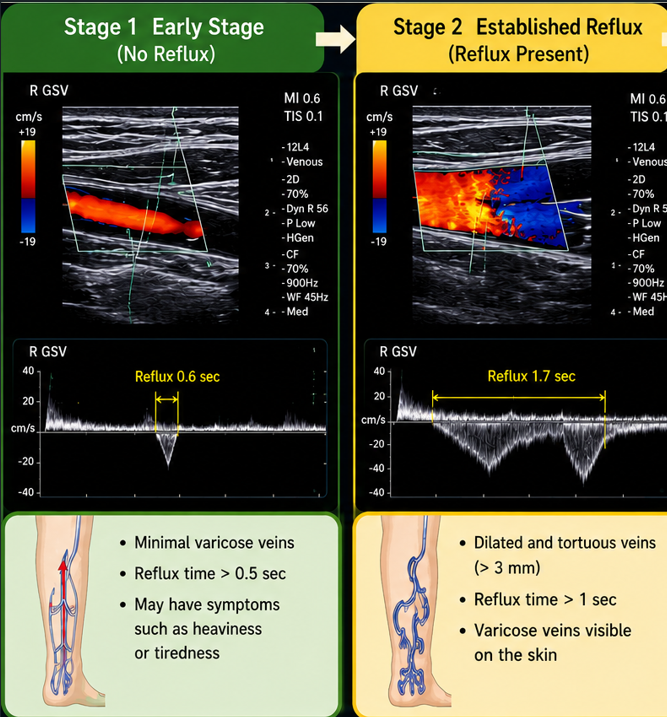
Stage 1 – Early Disease
- Minimal visible veins
- Mild symptoms
- Reflux time greater than 0.5 seconds
- Legs may feel tired or heavy
Early diagnosis often prevents disease progression.
Stage 2 – Established Venous Reflux
- Enlarged varicose veins become visible
- Veins become twisted and dilated
- Reflux exceeds one second
- Symptoms become more noticeable
Treatment during this stage usually provides excellent long-term results.
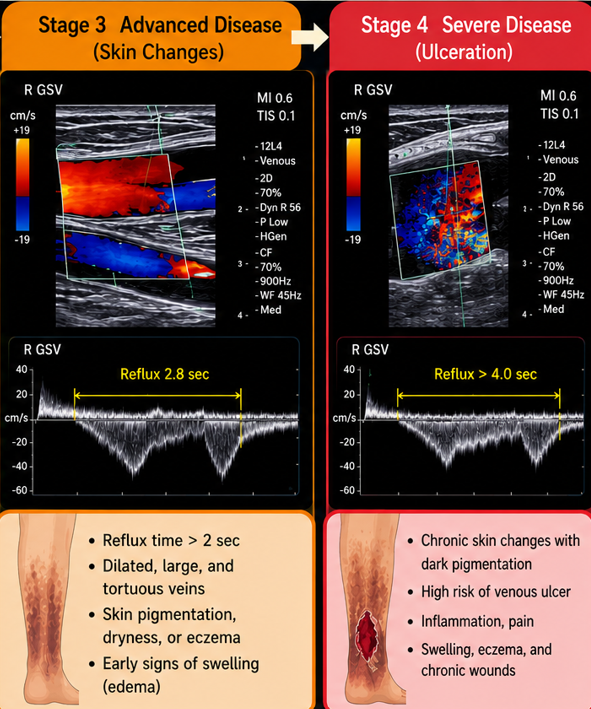
Stage 3 – Advanced Venous Disease
The disease begins affecting the skin.
Patients may develop:
- Brown skin discoloration
- Eczema
- Dry skin
- Leg swelling
- Chronic inflammation
At this point, delaying treatment may increase the risk of complications.
Stage 4 – Severe Venous Disease
This is the most advanced stage.
Patients may experience:
- Venous ulcers
- Chronic wounds
- Persistent swelling
- Skin hardening
- Pain and recurrent infections
Treatment becomes more complex, making early diagnosis especially important.
Can Ultrasound Help Determine If You Need EVLA?
Absolutely.
Endovenous Laser Ablation (EVLA) treats the diseased vein responsible for venous reflux.
However, not every enlarged vein requires laser treatment.
The ultrasound identifies:
- Which vein should be treated
- Which veins should be preserved
- Whether laser treatment is appropriate
- The optimal treatment plan for each patient
This personalized approach improves outcomes while avoiding unnecessary procedures.
Symptoms You Should Never Ignore
You should consider a Venous Duplex Ultrasound if you experience:
- Visible varicose veins
- Leg heaviness
- Aching legs
- Swollen ankles
- Night cramps
- Itching around veins
- Skin discoloration
- Slow-healing wounds near the ankle
- Family history of varicose veins
Early diagnosis often means simpler treatment and better long-term results.
The Bottom Line
Treating varicose veins without a Venous Duplex Ultrasound is like repairing a home without knowing where the water leak begins.
The visible veins are only the symptom.
Finding the leaking vein is the key to successful treatment.
Venous Duplex Ultrasound is the foundation of accurate diagnosis, personalized treatment planning, and long-lasting results.
If you are experiencing symptoms of varicose veins or chronic venous insufficiency, schedule a Venous Duplex Ultrasound before deciding on treatment.
Knowing the source of the problem is the first step toward healthier legs. Please do not hesitate to contact us with any questions via Whatspp +66818846638